KPop Demon Hunters (2025) Review – With Eyes East
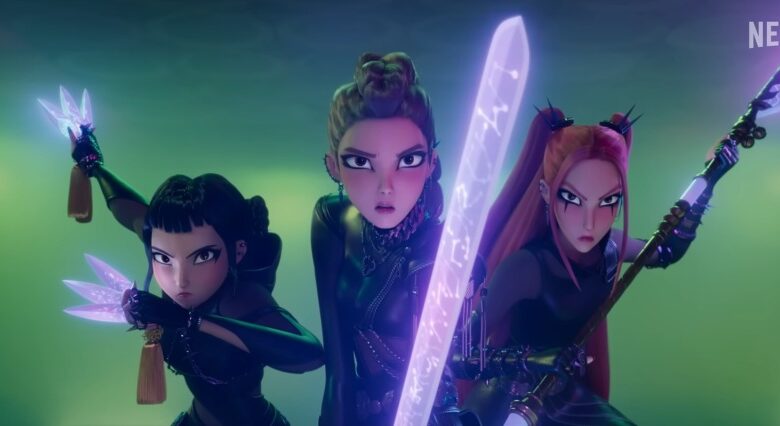


Directed by Maggie Kang, Chris Appelhans
Starring Arden Cho, Ahn Hyo-seop, Lee Byung-hun
Yes, they really spelled it like that
I have a friend who’s a bit of a troll. She wanted to watch KPop Demon Hunters and wanted more, perhaps, for me to watch it. Her logic was sound: “You like K-pop!” to which I noted I also like movies, and that doesn’t mean I’m rushing out to watch F1 this weekend. Nor for that matter, Elio, live-action Lilo & Stitch, or live-action How to Train Your Dragon – really, guys? Three at the same time? Anyway, my logic here is sounder: those movies are for babies. Of course, I’ve enjoyed movies for babies, especially when I was a baby, as well as movies empty of thought or weight. One doesn’t need to approach a work of art or entertainment in the exact same way each time, and we understand this implicitly, setting different expectations based on genre, content rating, and so on. Still, a lot of the criticisms I have for KPop Demon Hunters can be brushed aside with “It’s a kids’ movie,” leaving me in the impossible situation of having watched a movie I wasn’t meant to watch.
Even the phrase “a lot of the criticisms I have” hits the eye wrong, due in part to a glancing understanding of its production. Korean-American filmmaker Maggie Kang wanted to tell a personal story, in effect marrying the heritage of the old country to its modern incarnation as pop culture powerhouse, and I don’t disagree with that project. I don’t disagree with the narrativizing of the K-pop idol, either, whose teacup overflows despite her (and his) vow of silence. Girls’ Generation and Jessica Jung simply pretend like the other doesn’t exist, which has made for a maddening decade and counting. There’s also the netizen problem – sasaengs and anti-fans alike – and how the industry sharpens South Korea’s competitive society to a knife point, printing sensational headlines about plastic surgery, abuse, and even tragedy. I mean, that’d be if you worked backwards and made a biopic about a group with those elements as part of their history, but a skillful hand could surely make, say, a compelling IU movie. She hasn’t generated controversial headlines, but has certainly experienced the triumphs and failures, fears and hopes to excite and affect a moviegoing audience.

KPop Demon Hunters isn’t really about any of that. Maggie Kang’s not in K-pop herself, but she’s been a fan far longer than I have – if this review feels like a laughably misguided credentials thing – though the involvement of Twice is hard to miss (stick around for the credits). The film’s idols aren’t concerned about an upcoming performance or a 15-year anniversary reunion or anything especially mortal. They’re demon hunters, in that they practice high-flying martial arts upon humanoid ghouls, with the twist that their music powers a magic barrier separating the human world from the underworld. Now, the term “hunter” is used loosely. Our first set piece comes from a thwarted demon trap aboard a private jet rather than high-heeled gumshoes and a big map which even the derivatives of Supernatural on The CW often managed. I understand that this is a movie for babies, but there is an interesting rationale. The idol group is called Huntr/x, and they’re even bigger than Twice! The hunt is over; when we meet them, they’ve already won. And so, an enterprising demon decides to create a competing demon boy band to siphon Huntr/x’s influence and weaken the barrier.
This means that Huntr/x will write a diss track against their new competition, Saja Boys, which is something foreign to K-pop. Unless you remember that time Blackpink totally ate BTS. Based on cursory research, when K-pop artists get aggressive with their lyrics, it’s usually targeted at “haters” or agencies or other industry-related institutions, but not each other. And that’s a useless gotcha, it’s just that the movie’s plot requires a kind of conflict that its real-world subject matter can’t provide. More to the point, then, Huntr/x is a three-member group – vanishingly rare outside of subunits – but KPop Demon Hunters is very much a story about one member alone. As we discover, leader and vocalist Rumi is part demon, and she’s been hiding her demon markings from the world and her fellow group-mates Mira the moody dancer/visual and Zoey the bubbly maknae. If you’ve been reading this blog for any amount of time, you know that one of my favorite things about K-pop is the group dynamic. Idols train, work, and even live together for years, so making Huntr/x a trio rather than a soloist feels like a missed opportunity. Cynically, it’s that groups like Itzy and BigBang are what we think of when we think “K-pop.” It’s set dressing.

On the flip side, the visuals of the film are infused with symbols of Korean culture and pop culture, from the thoughtfully aesthetic costumes to the folkloric tiger inexplicably dubbed “Derpy tiger” in official material. Unfortunately, the world of KPop Demon Hunters doesn’t feel populated. It looks right, but these Simpsons don’t inhabit a proper Springfield, outside of one doctor (in an unhelpfully non-sequitur sequence). Like, where are all the people? What are they seeing when there are demons? The fans are rabid and heart-eyed, and their loyalty turns on a dime, but you can’t keep telling me the world is at stake when that’s the whole world. I just don’t know, man. I don’t remember Disney and Pixar movies feeling so airy. Even Shrek had biomes. Spider-Man: Into the Spider-Verse takes place in New York City, but it’s got that wild visual style. The Seoul (?) of KPop Demon Hunters is so mundane, a background cleaved from the foreground.
Look, if I’m gonna catastrophize about anything these days, it is not the current state of children’s movies, but the thought did occur that by its standards, this feels Xeroxed. It has strengths in superficial places, resting upon old romcom bones and delivering an abrupt message of self-acceptance that’s heard but not felt (by me, an adult man). Why was Rumi’s mother figure only in, like, two scenes? It’s also a message hardly unique to K-pop. We’ve watched ogres and Mulans the world over learn to accept themselves, and while the mechanism of this one is clever (recognizing self-hatred once it’s reflected in another), its very existence is set up with exposition, not emotion. You’re a demon, Rumi, and in a practical sense, that means nothing. Well, it could mean that we’ll see a KPop Demon Hunters 2 before an IU biopic, so I’m left with one final question: Why are all the songs in English?

PS: After Predator: Killer of Killers, I think I’m all set with this Spider-Verse animation style where the in-between frames stutter and my eyes go like this.